Historical
A Margin That Changes the Drawing
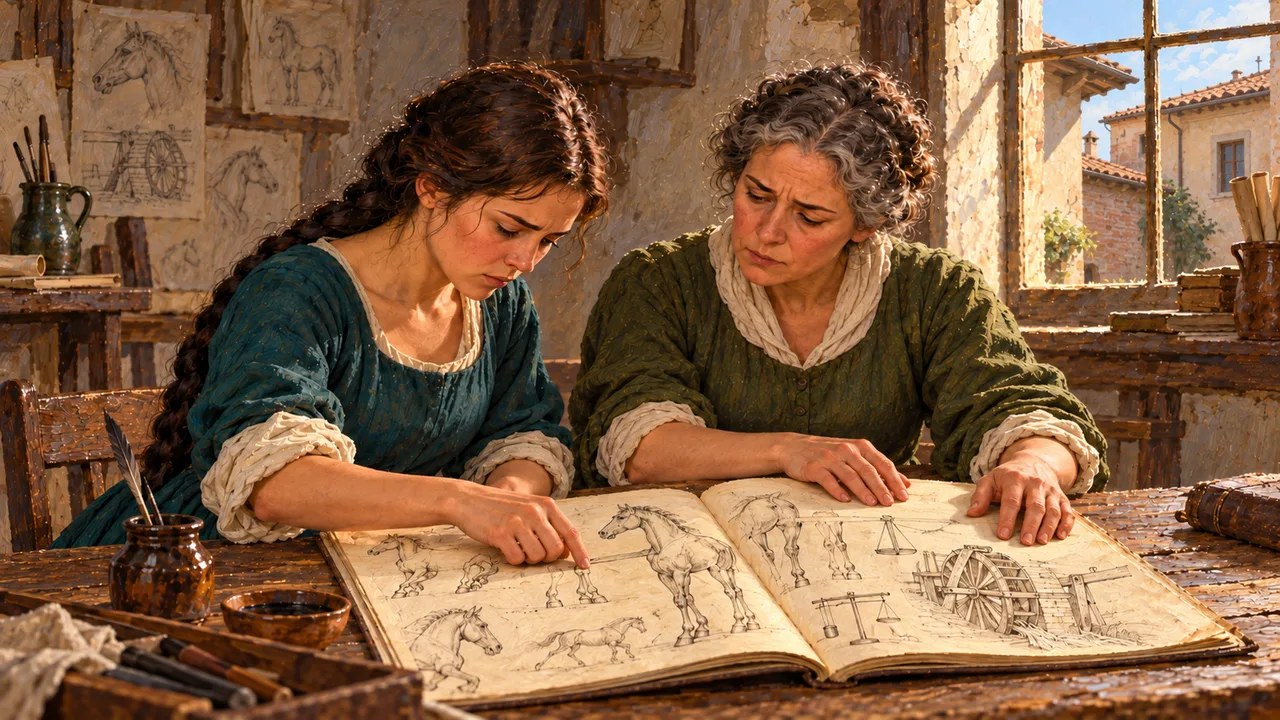
Beatrice bought the folio for its horses. You have spent three days copying their legs without improving your own opinion of your line. Among the horses lie water wheels, balances and notes copied in the backward script associated with Leonardo. Some sheets are clearly copies of copies. Beatrice’s seller called every mark the master’s hand, which is a fine claim for a man already paid.
Your choices shape the journey
Choose an approach, work through a puzzle or skill check, and decide how to respond when the story asks something of you. Return to explore another ending.
This is a complete free adventure. Your progress stays in this browser; use the reader’s export option to keep a backup.
Before you begin
Period injustice, forced labour, slavery, dangerous work and war injury. Characters and incidents may be fictional.
No age rating or fixed reading-time promise has been assigned. Read the guide and content notes.
Historical context
Leonardo’s drawings, observations and mirror writing supply real context, but he never appears or speaks here. Ines, all other immediate characters, cipher, invention and correspondence are fictional. The 1500 working copy is not the Codex Arundel, whose core began in 1508, or a real Forster codex. The V&A notes later assembly and nonlogical ordering; this fictional puzzle therefore uses visible water-flow relations rather than assuming modern page order was Leonardo’s intended sequence. Rosa’s ordinary casting-measurement copy travels from Mantua with a paid workshop courier two years after Book38; it carries no outcome-dependent secret formula.